

After having an unrealistic ambition of benchmarking every signing for Rangers and Hearts last summer, I decided to conduct a modified realistic version for the January window. Hearts is easy to summarize - coherent signings that will probably not move the needle as long as Derek McInnes remains manager and anchored in his ways.
Rangers are much more complicated with Danny Rohl’s arrival coinciding with an uptick in defensive solidity but attacking output and chance creation a persistent weakness. To put this issue into some context, Rangers xG from open play has averaged 18% less than the 2018-2019 team and down 24% from last season’s.
It has improved from what was a diabolically bad 8th-in-the-league rate under Russell Martin moved back into a distant 2nd behind Celtic during Rohl’s tenure.
The gap in open play chance creation has been a persistent deficit for Rangers, with only the 2020-2021 team in a virtual tie. Rangers’ highest performing side in open play was the 2022-2023 team that went to the Europa League Final, but only at a rate marginally higher than this season’s depressed Celtic vintage.
Enter the January window.
While the decision making hierarchy for the window was unclear given the autumn departure of Kevin Thelwell, the arrivals of Ryan Naderi, Tochi Chukwuani, Andreas Skov Olsen, and Tuur Rommens all appear to be coherent and of good quality…unfortunately.
I had heard from a reliable source in early January that Rohl had decided the best way to get more attacking output from his squad was to migrate towards more of a Red Bull-like game model. For those who may need a refresher, it prioritizes a narrow shape and aggressive vertical passing - not necessarily direct in an aerial sense. Counterpressing and winning second balls to catch opponents in moments of transition fearture prominently.
As the window unfolded, this looked potentially evident when Olsen, Chukwuani, and Rommens were signed in close proximity, but they could have reasonably fit the prior game model. It was Naderi’s signing that set off alarm bells that the migration may actually occur, and the Scottish Cup game versus Queens Park was the first trial run.
Rohl lined up in a 4-2-2-2 with Naderi and Miovski at striker, Olsen and Antman as inverted forwards/#10, and Diomande and Chukwuani as the midfield two.
For whatever reason he reverted to a 4-3-3/4-2-3-1 in the draw away to Motherwell, then went back to the 4-2-2-2 against Hearts, with Chermeti in for Miovski, Moore for Antman, and Raskin in for Diomande.
My analysis agrees with Rohl’s assessment, if it is the case. Rangers’ squad was better aligned with the Red Bull-esque model even before the January window, and I will use Naderi to highlight why I think the January window may accelerate their improvement in attacking output if Rohl is consistent and effective in adopting it.
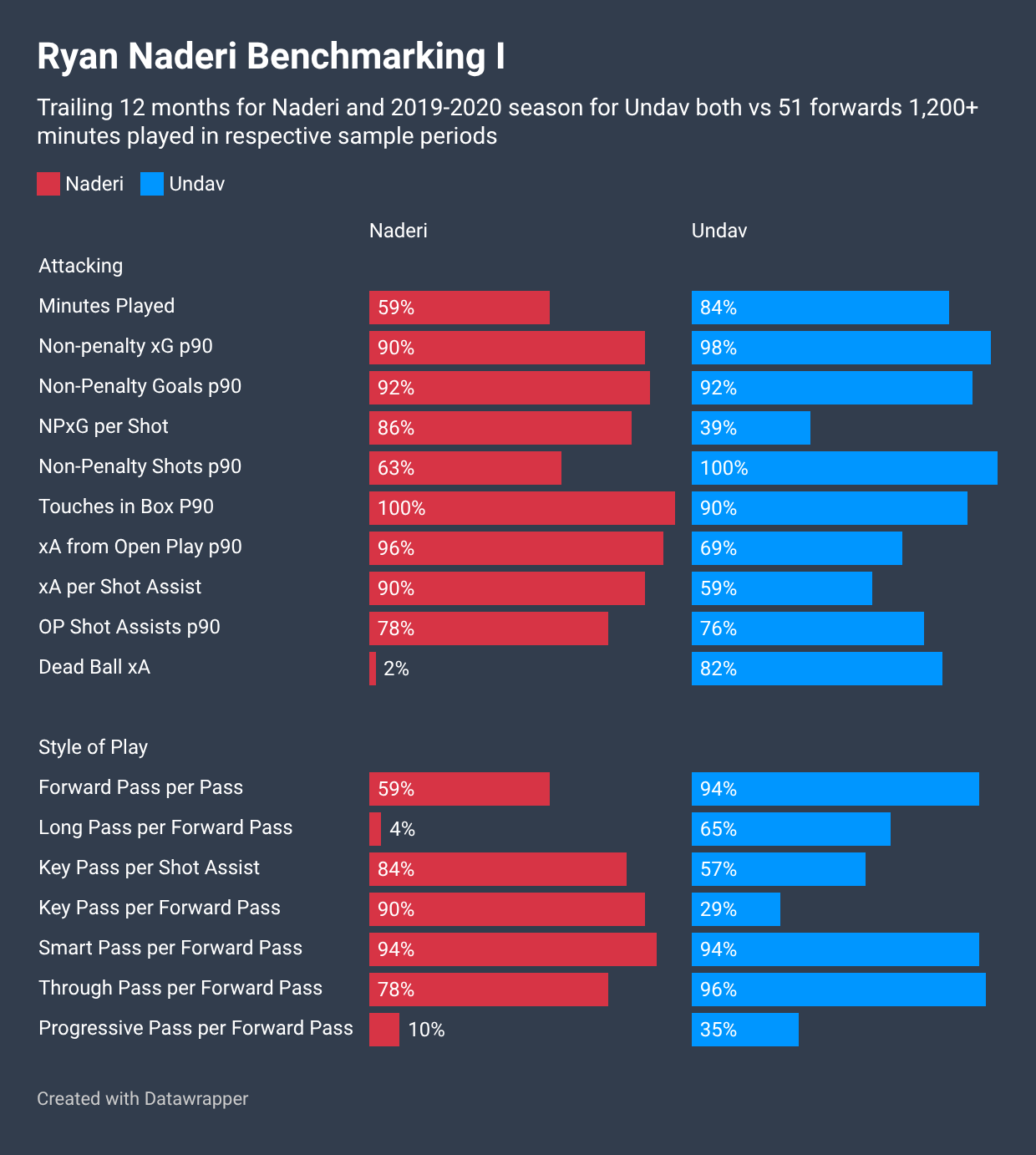
Naderi was signed out of the German third division, and on the eve of Celtic facing Stuttgart in the Europa League, Deniz Undav was another player plucked from that level who has gone on to be a productive player at a much higher level. I am not suggesting they are similar players - they are not. I use Undav’s last season at the same level to frame the relative dominance, or lack there of, in certain performance metrics at that level.
Naderi played mostly in a 2-striker setup during the relevant 12-month trailing period, with 4-4-2 diamond the most frequently used formation per Wyscout. His attacking output was dominant on a team that was 11th in goal scoring last season and 7th so far this season, so not a dominant side.
Importantly, his markers for decision making and for being a potential higher IQ player are excellent. His xG per shot and xA per shot assist rates were both 60%+ higher than his team’s rate. He was the opposite of a “compiler.”
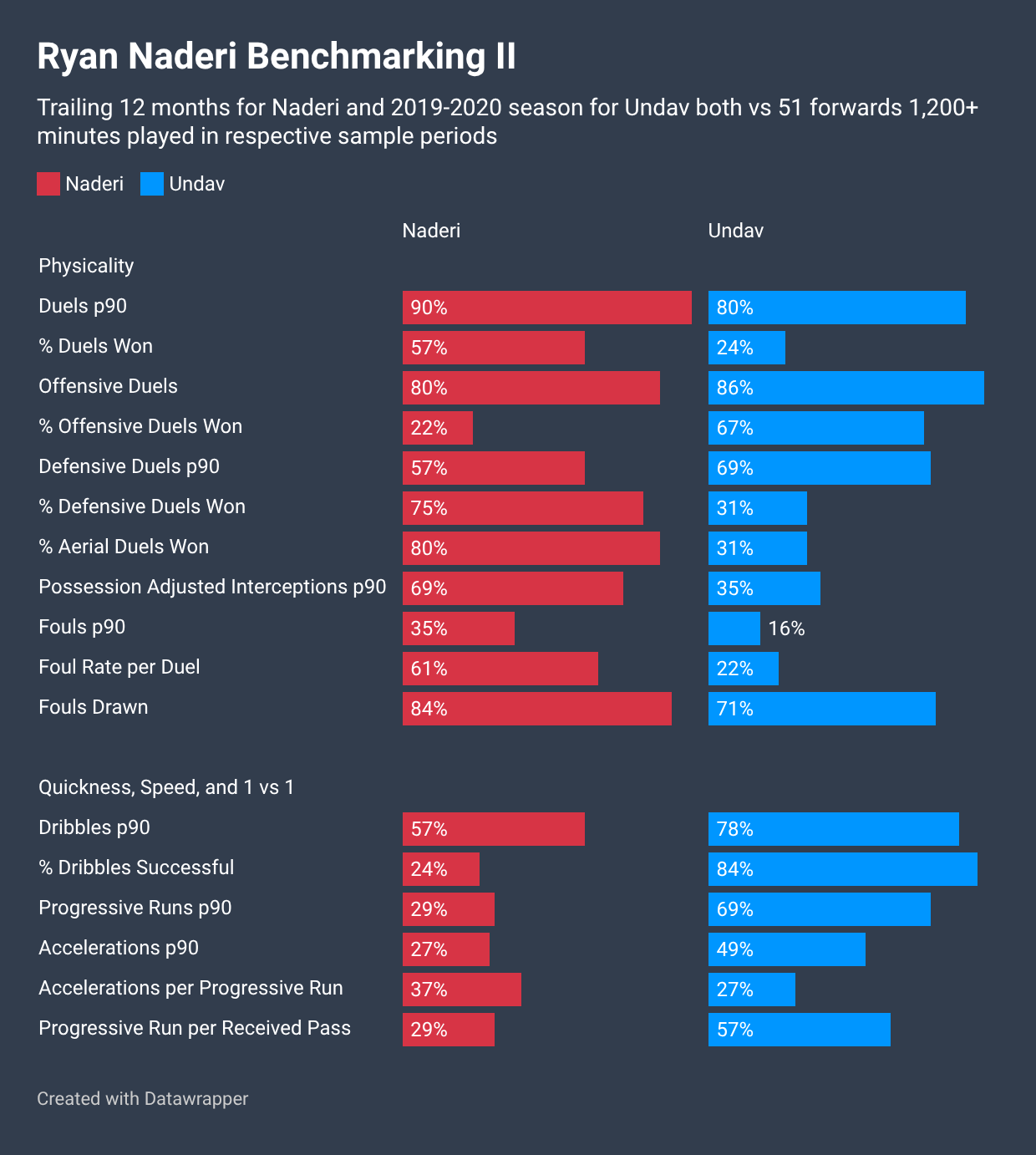
Here we see some profile and stylistic differences emerge between two players, with Undav more explosive runner and likely a better technical player on the ball, overall. Naderi appears a willing and capable on-ball defender, good in the air, and with additional markers for IQ via interceptions and foul rate metrics above average.
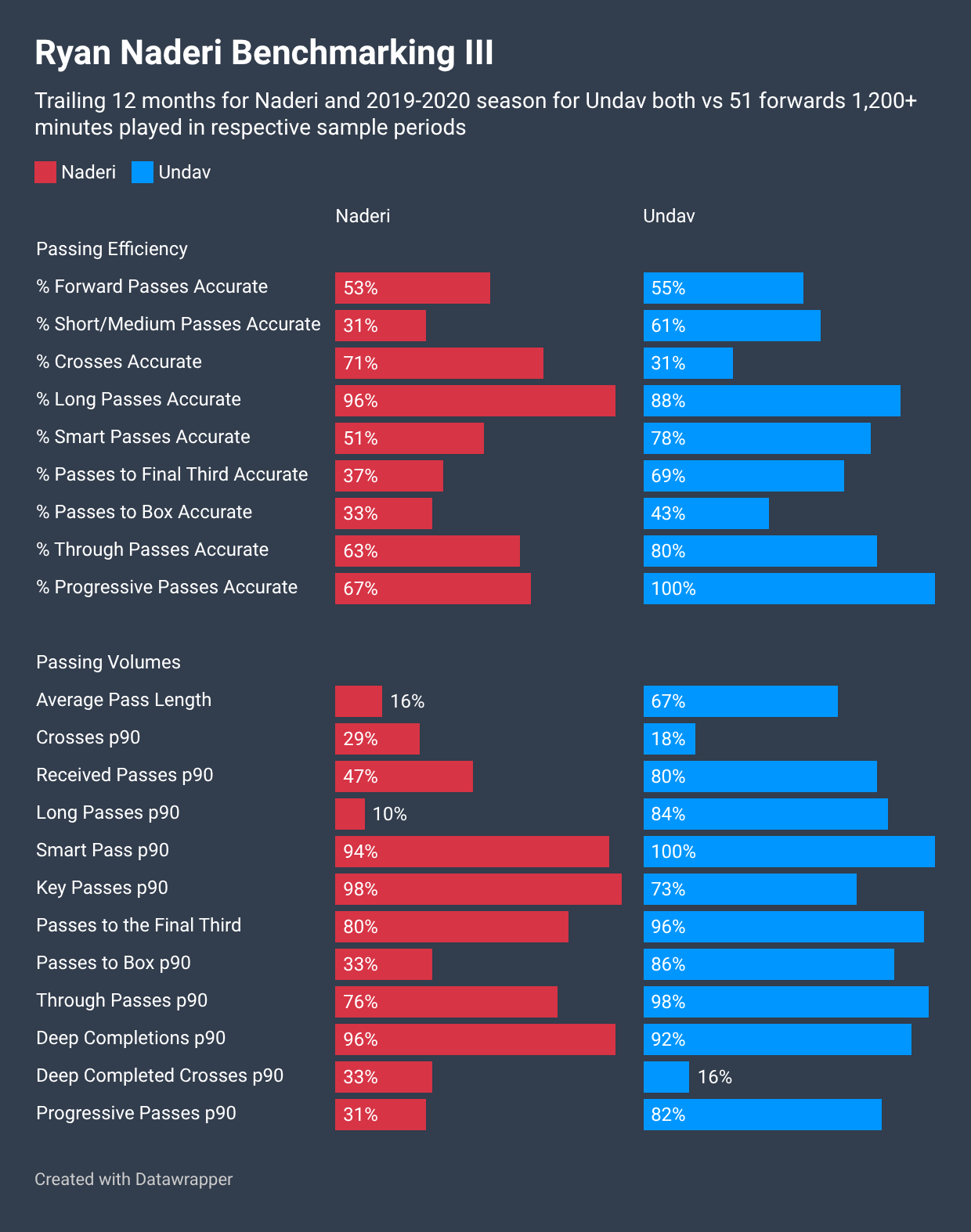
Undav was more involved and effective in buildup and played some limited minutes as a #10 that season, where as Naderi was more of a 1 or 2 touch striker when involved in holdup/buildup. Naderi’s low short/medium passing efficiency is a red flag, especially when combined with his other passing efficiency metrics.
Red flags are useful in serving as catalysts for additional inquiry, and in Naderi’s case, technical ability is probably not a relative strength, though not a big weakness either. I think his lower efficiency rankings are more to do with his passing mix - i.e. he takes a LOT of risks, as reflected in his volume rankings for deep completions, through passes, key passes, and smart passes. Combined with his metrics in the first image above, I suspect his risk/reward profile lands favorably on the “reward” side of the ledger.
Video Review
Naderi strikes me as a crafty player but appears to lack explosiveness or game-changing pace. This is not to suggest he is unathletic, as he appears very dangerous in other ways.
For a bigger guy, he seems to have very good body control, coordination, and what I label as “good feet” in the video. He’s probably better with limited touches as his deficit in quickness is likely to see him overwhelmed with swarming defenders in Scotland, but the confluence of those factors with what appears to be good spatial awareness and decision making, as well as adding another weapon in the air for set pieces and aerial crosses, makes him pretty compelling despite the lack of quickness and speed.
Analytical Conclusions
If Rohl lines up with Naderi as the sole striker in a 4-2-3-1 and asks him to play as a false 9, then this signing could be a disaster. As we see repeatedly at Celtic, playing players in poorly profiled roles can be a big problem - see Balikwisha as a recent higher-cost example.
My grading for Rangers’ window is heavily dependent upon Rohl following through on his migration to the new game model, for which Naderi is “custom built,” IMO. It also suits Olsen, Moore, and Antman. Olsen and Moore, in particular, present upside in more freelance roles where they can move in and outside interchangeably.
They also have the profile and depth in midfield to play the deeper 2-man role, with Chukwuani well aligned with the role. His combination of size and pace, along with a reasonable, if unspectacular, proficiency on-the-ball makes him capable of covering a lot of ground and winning 2nd balls. Rommens provides a coherent attacking fullback profile to compliment the more narrow box in the forward areas.
Given Rangers’ effectiveness on attacking set pieces, adding additional weapons may further enhance their threat while also improving what has been more of a mediocre defense in that phase of play.
It is from open play where material improvement is plausible, and likely needed, if Rangers are more likely to win the title. While the overall volumes have been well below required levels, average quality has also been poor, including being 7th for xG per shot from open play during Rohl’s tenure.
Following last week’s midweek game at Motherwell, Rangers now play one game a week for the foreseeable future, with ample time to train a new game model. My base case is that they will level-set higher from open play and possibly approach parity with Celtic, with a material advantage persisting on set pieces.
Combined with reasonable depth across all positions, they are likely to pose a persistent and robust challenge over the remainder of the campaign.
Do you think there is negative bias in that you might tend to look for negatives in Celtic signings and positives (from their perspective) in The Rangers signings?
Think they had a very good january window, in contrast to ours. If they deploy the 4222 they used against hearts I think their chances of winning the league increase to a pretty significant degree. Our upcoming trips to ibrox are a concern if we play more direct, that midfield will eat ours alive in terms of winning second balls.