

As Celtic celebrate another SPFL league title, their 14th in 15 years, attention outside Celtic Park focussed almost solely on refereeing decisions deemed decisive in the final matches of the season. May mayhem, indeed.
No, Minister
Hitherto absent politicians weighed in with calls for enquiries, and for Celtic to forfeit the title to Heart of Midlothian.
There truly is nothing like Scottish football for sheer entertainment, intended or not.
The refereeing scrutiny was reignited upon publication of the regular report from the Key Match Incident (KMI) panel. This further flamed the fires for those wishing Celtic expelled, disbanded, “set down the leagues” and so forth.
It came down to two decisions involving Motherwell, at home to Hearts and to Celtic. In both instances the KMI were split on whether Alexandros Kyziridis should have had a penalty for Hearts, and whether Sam Nicholson should have conceded a handball penalty to Celtic. Both felt the final Video Assistant Referee (VAR) actions to be “incorrect”.
I’ve been doing this a long time (taking a data driven approach to assessing refereeing performances), so was mildly amused to witness so many new to this game not so much dipping their toes in the water but diving off a cliff headlong into the Atlantic.
Wherever corruption and conspiracy were insisted upon, I asked a simple question on social media platform X: “What has been the impact of poor refereeing calls over 38 matches?”. The season, of course, lasts 38 matches not two. Performances and big decisions have an impact on any match whether in August or May. To suggest corruption or conspiracy, you would expect to see patterns going back over a statistically significant number of matches and time. We know a song about that, don’t we?
Sadly, no one knew the answer.
A commonly used term from my working life was to “eat your own dogfood”. Meaning, if you are going to define policies and procedures by which staff must operate, be sure to operate them cleanly yourself.
In that spirit, I have analysed all the decisions over the season by the KMI and using a framework I have developed for assessing refereeing calls, can estimate an expected points impact of each wrong call. Thus, at the end, we can assess who has benefitted from, and been penalised by, poor calls over the season.
But first, what is the KMI?
The KMI
For a full explanation, please follow this link and click on “KMI Review Panel Explained”.
It is an independent panel of three individuals drawn from a pool of people: one “an established career in Scottish football”, one laws of the game expert, and one representative from the clubs.
Their decisions are advisory and for communication only. The canonical version of history is established by the SFA and their match assessors and some are discussed on Willie Vision. Not all decisions debated at KMI make it onto Willie Vision – the SFA VAR Review Show to give it the Sunday name.
Collum can and has and will provide a different view and explanation for a decision than that opined by the KMI. Backed up by the audio and video, and of course, he runs the expert body and knows what guidance and training has been provided.
However, mainly because it suits narratives, the KMI panel “decisions” have been treated by the wider Scottish footballing community as canon in the past week.
Let’s run with it: after all it is a more comprehensive and written account of decision reviews than we get from Willie Vision.
Impact of Decisions
The impact of refereeing on Scottish top-level football has become a specialism in recent times. My starting position was along the lines of “That’s a lot of intransigent noise. Surely the data will show few patterns to back up the wildest of imaginations”. Oh boy, did I get that wrong. Anyway, back to current day.
Assessing the impact of a decision deemed “incorrect” at KMI involves the following components:
1. The time the incident occurred;
2. The score at that time;
3. A model that estimates given the time and score, how many points each side is projected to win; and
4. A calculation to establish the impact on those expected points (xPts) caused by the decision.
So, for example, with the score 0-0 in the 90th minute, a penalty is awarded to the home team. At 0-0, the home team is expected to end up with 1.1 points (slight home advantage – more likely to score in added time) and the away team 1 point.
The 90th minute penalty changes this radically. The home teams expected points goes up to 2.8 xPts. An increase of 1.7 xPts from the 1.1 they already had at that time and score. However, as it is a penalty, and those are scored 77% of the time, this is adjusted to a 1.31 increase in xPts.
The away team would expect their xPts to drop from 1 to 0.05 (a 0.95 xPts drop) should a goal be scored in the 90th minute. Because it is a penalty though, it decreases by 0.73 xPts.
So, the impact of an incorrect penalty in the 90th minute is to increase the home sides xPts by 1.31 and decrease the away sides by 0.73 xPts.
This works without the 77% adjustment for goals wrongly allowed/disallowed.
For sendings off, having analysed five seasons worth of data, there is an average negative impact on the card receiving side depending on what time the card is issued.
Thus, we can assess the estimated impact of penalties, red cards, goals disallowed or allowed incorrectly.
2025-26 Season
The KMI publishes a written report within days of each match round, and they can be accessed and downloaded in the link above.
In 2025-26, the KMI analysed 355 decisions and deemed 26 of them to be incorrect. This represents an 7% error rate even allowing for VAR intervention. Three were in Cup matches so are ignored for this analysis. That leaves 23 incorrect calls in the SPFL Premier League. As I mentioned, not all are unanimous verdicts – a 2:1 split is not uncommon.
Not all incidents have any impact on xPts. For example, in January, Graeme Shinnie was sent off with a straight red card at Kilmarnock. The KMI panel opined it should have been a yellow card, which would have been his second, thus rendering him sent off in cany case. Thus, the incorrect decision had no material xPts impact.
Also, although not relevant this season, a 6th goal in the 85th minute in a 6-0 win, is effectively immaterial in xPts.
However, in summary, 23 wrong calls in the league, impacting teams as follows from a simple “counting” perspective.
Benefitted From A Wrong Call
· Falkirk 4
· Hearts 3
· Livingston 3
· Aberdeen 2
· Celtic 2
· Hibernian 2
· Motherwell 2
· St Mirren 2
· The Rangers 2
· Kilmarnock 1
· Dundee 0
· Dundee Utd 0
Penalised By A Wrong Call
· Motherwell 4
· The Rangers 4
· St Mirren 3
· Dundee Utd 2
· Hearts 2
· Hibernian 2
· Kilmarnock 2
· Livingston 2
· Celtic 1
· Dundee 1
· Aberdeen 0
· Falkirk 0
Decision Impact
The impact of those calls is estimated to be as follows:
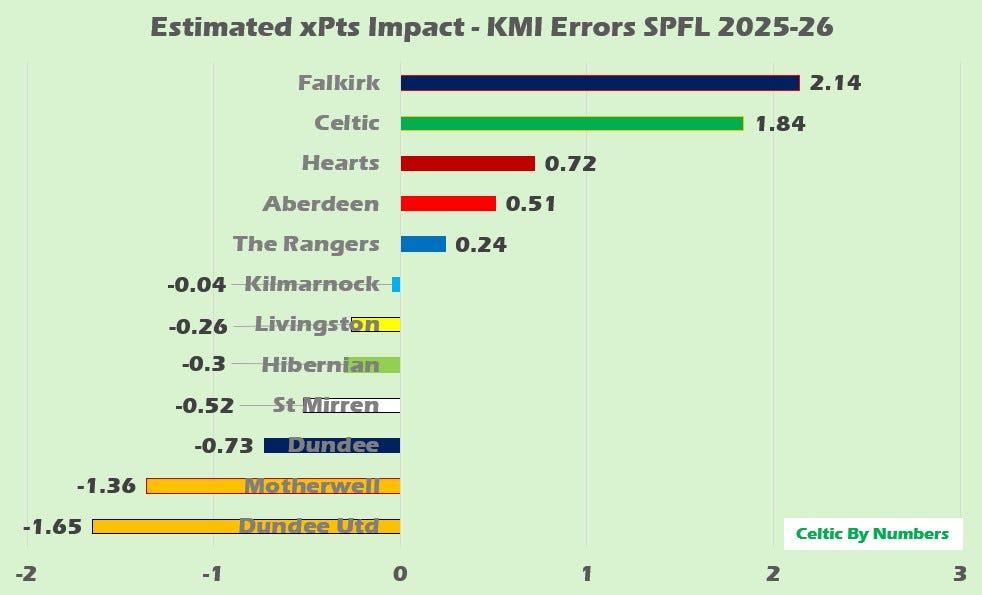
The main takeaway is that over a season the cumulative impact for and against of decisions deemed “incorrect” was, at most, just over two points for any single club.
Why are the politicians not taking up Parliamentary time with demands Falkirk be disbanded and charged with corruption? What hold does John McGlynn have over these people? I am sure we will be told.
More germane to the title race, Celtic are estimated to have benefitted from just under two points. However, Hearts have benefitted by 0.72 points, or 1.12 less benefit than Celtic. Netted out, that would not quite be enough to make up the two points by which Celtic won the league.
Eight out of 12 clubs saw differences in xPts of less than one point positive and negative, due to incorrect decisions.
Football is a game of fine margins. With technology we should strive to improve outcomes for all clubs. The data driven evidence is that in the SPFL, none of these expected points differentials would be sufficient to change any of the final standings.
The Variance Monster
If I may be immodest for a second (these jokes write themselves), as well as a data driven approach to refereeing assessment, my other developed specialism is in attempting to build a framework for assessing variance in football.
It is a low scoring sport, and goals are huge events in matches. A lot of stuff happens over 90 minutes in such a dynamic sport, some of it controllable and some of it uncontrollable.
Variance can have a material impact on results. What do we mean by “variance”? There are obvious events that you cannot coach for such as own goals, red cards, penalties and refereeing errors.
What is the impact of those events?
Using the framework above we can estimate for that.
One other important data point to introduce at this stage, to enable us to map from expected goals to expected points. Over more than 10 years of SPFL results data, we can use the following constant: each +1 in goal difference is worth, on average, 0.6 expected points.
Armed with all this public data, we can estimate the impact of variance on each season.
Here is the estimated impact of largely uncontrollable variance events over the season:
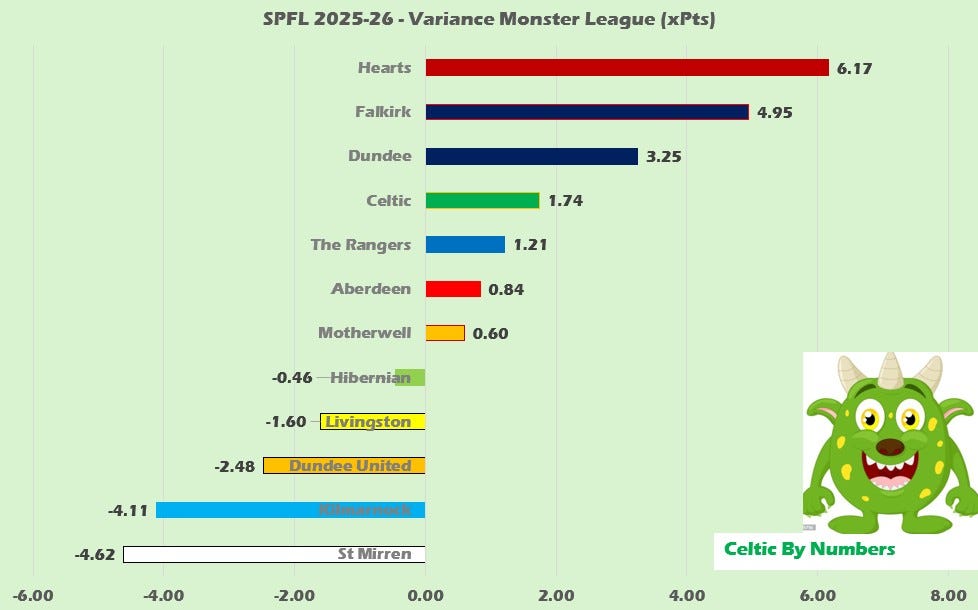
Yes, it was plucky Hearts who most benefited from the unplanned slings and arrows of football variance. To the tune of over six points! Now that is starting to look potentially material and position changing.
The main drivers for Hearts were a positive penalty count of 5-1, and four opposition own goals.
To take over Hearts, Celtic had to make up around four points of misfortune on the field. Anyone who watched Celtic play will realise that was slightly surprising!
Poor old St Mirren were nearly five points worse off than if they had an equal dowsing of variance, although that would not have altered their position.
Just to say there is nothing particularly remarkable about any of this. I have modelled this in the SPFL back to 2020-21. The highest positive variance in that time was Celtic in 2023-24 with 8.08 expected points thanks to those unplanned events. Ross County with -7.07 in 2020-21 experienced the worst outcomes over a season.
So, the point is, there are other factors at play over and above poor refereeing that influence the outcome of football matches and have more material impacts in final points.
I have not even introduced THE most important factors: the vagaries of finishing and goalkeeper play at either end. Those have much greater influences on outcomes and are to some extent more controllable, but not entirely so.
Summary
The KMI is an advisory and opinion giving body with no executive power over refereeing performance. However, they do document fully VAR decisions in every match and provide a comprehensive source for data analysis.
Analysis of incorrect refereeing decisions can result in an expected points estimated outcome based on simple match state metrics.
In the 2025-26 season, the estimated impact of incorrect calls was very small and would not have changed any league position.
Other variance factors are more material to footballing outcomes over the season and can similarly be modelled.
Hearts have enjoyed the “right” end of those variance factors when all 38 matches are considered.
None of this will deter the terminally stupid.
Just because you've done the analysis doesn't mean it's not Dermot Desmond/Peter Lawell conspiracy to ..... 🤪
Great piece of work Alan…now if only reasoned thinking breaks out across Scottish football!