

Despite the last league game being completed nearly a month ago, Heart of Midlothian players are still complaining about “injustice” in how the league ended.
The ingrained institutional hurt from 1986 clearly still infects the collective immune system of the club. To have a last-minute repeat some 40 years later is indeed a deep psychological blow.
However, narratives in Scotland from those disappointed by another Celtic title triumph tended towards the selective. Yes, Hearts were unfortunate not to get a penalty at Motherwell. All projected analysis ignores the possibility that the penalty might have been missed (23% of them are), or that Motherwell, with more than 30 minutes to play, may have scored further goals.
Equally, the last-minute penalty Celtic received, also at Motherwell, could also be described as fortunate given the Yorkshire Whistler felt it should not have been given. The sense of deflation at Tynecastle when the news of the late winner filtered through, and the mathematics went from “almost certain league winners” to “must get at least a draw away at Celtic” was palpable. The need to rationalise this must be overwhelming. Goaded on by a partial press, the last month or so has been an education for anyone not familiar with the cultural proclivities of the Scottish football ecosystem.
What most analysis also failed to account for in the race to “other” Celtic and sooth pain, was the cumulative impact of decisions deemed incorrect over the season. You can see an assessment of that here.
What many prominent members of Scottish society, with their newfound interest in football, and passion for Hearts, ignored was the impact of variance in general over football and this season’s title race. The (near) end of season Speedboat collection has that covered.
In addition, we have had the fifth year of a professional, Yorkshire based referee passing expert and neutral opinion over key decisions impacting Celtic and The Rangers. This Sheffield Wednesday supporting official brings insight and balance to the wonky world of Glasgow football excess. But it is not for me to praise: the proof is very much in the five years’ worth of pudding. Sincere thanks from me are, however, in order.
Hopefully he will return next season work commitments allowing, and maybe we need to include the team that seem apparently joined at the hip with The Rangers as far as predominant fan sentiment goes, in Hearts.
This is an important pillar, and is only ONE pillar, in a range of data points that can assess refereeing performances. So, here is your annual review of what happened in 2025-26.
Error Rate
Decisions are referred to the Yorkshire Whistler based on factual outcomes such as all dubious goals, red cards and penalties. Offsides are not referred given the impossibility for him to review VAR footage, unless they are noteworthy in any way, such as Celtic’s 87th minute winner against Hearts.
Otherwise, it is what is contentious (within the framework of red cards, penalties, goals allowed or disallowed) on BBC or SPFL highlights shows. Social media also tends to raise up the debatable calls.
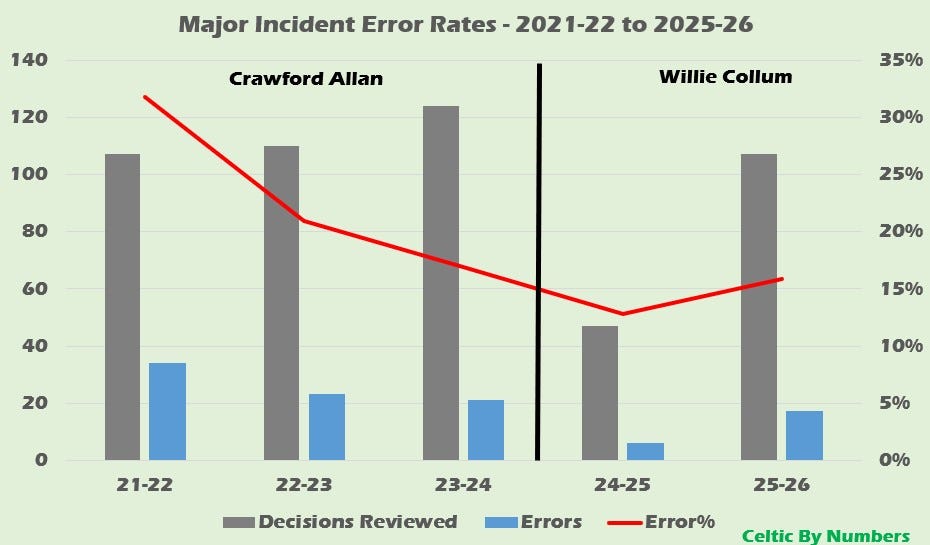
Here are the year-on-year trends as regards the decisions referred and the error rates.
The need for an independent review of decisions became apparent very early into the appointment of Crawford Allan as Head of Refereeing. Remember, those were in the days pre-VAR. Also, this appointment coincided with the emergence of a competitive The Rangers after the new club rose (eventually) through the senior leagues.
VAR was introduced to Scotland in October 2022, as they rushed to get it in mid-season amidst fears Scotland’s referees would be left behind when it came to UEFA and FIFA appointments. Which has happened in any case.
Error rates have fallen in line with VAR usage but crept up again this season to be 16% of all incidents referred. Remember: this is only for calls made in Celtic and The Rangers matches.
Those that decry standards are not improving under Willie Collum’s guidance have a point as, objectively, given the lack of high-level UEFA and FIFA appointments (no Scottish officials are attending the World Cup this summer), SFA referees are not well regarded at the top level.
The error rate in the Yorkshire Whistler’s first season was an incredible 32%. VAR has certainly contributed to reducing that down by half, but with dedicated VAR officials, one might expect further reductions.
Wrong Calls
Of 107 decisions across 76 matches the Yorkshire Whistler was asked to review, 17 were deemed incorrect.
Those were:

Interestingly, Hearts feature three times and benefitted from wrong calls in each case! Pure cheatin’ ah tell ye.
In total, Celtic were on the end of seven bad calls, two benefitted them and five had a negative impact.
The Rangers were on the end of seven bad calls also. Two benefitted them, one had no impact on the outcome, and four were likely negative to their chances.
Impact of Wrong Calls
Simply counting calls and whether they are deemed correct or not does not provide any insight into the potential impact of those calls. That is where the expected points estimating model comes in. Based on the time of the incident and the match score at that time, we can estimate the impact on each teams expected points from the match in terms of whether there is a positive or negative change towards the quest for three points.
There were three highly impactful wrong calls this season, according to the Yorkshire Whistler.
Youssuf Chermiti thought he’d equalised for The Rangers at home to Hearts in September, in the 67th minute. The decision to chalk off the goal for a foul is estimated to have cost the Govan side 0.85 expected points.
In February, Mikey Moore was brought down inside the Livingston box in the last minute of a game locked at 2-2. This is estimated to have cost The Rangers 1.23 expected points.
Finally, Celtic’s penalty at Motherwell, also in added time, was similarly estimated to have benefitted them by 1.23 expected points. Remember that a penalty awarded is missed 23% of the time, which impacts the estimated expected points.
How does this impact the profile of estimated impacts over the period under review?
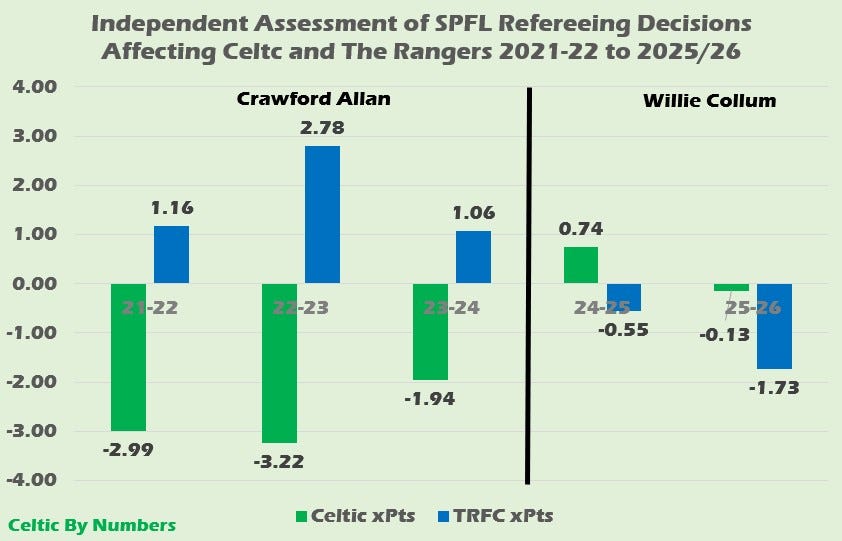
Under Allan, The Rangers benefitted by around 13 points over the three seasons reviewed, effectively sustaining title challenges that otherwise would have been over much earlier in the season. The smallest gap was four points in 2021-22, and so an average discrepancy of over four points per season could have been enough to swing the title.
Whilst those patterns of assistance towards one club are clear and consistent, and supported by other data such as the number of touches in the box per penalty awarded/conceded, the time and impact of each penalty, the impact of red cards, patterns have shifted since Collum was appointed.
The average discrepancy has more than halved to less than two points and are within a narrow enough band as to be considered expected levels of variance.
The question of overall refereeing quality remains a valid area of debate. The notion part-time officials can operate effectively in a sport where the players are increasingly fast and athletic is risible. Similarly, the same referees abide over time, drawn from too narrow a demographic within Scotland. Incompetent and unfit referees are promoted to full time VAR roles.
However, it appears that transparency through the SFA VAR Review Show, and the weekly publication of the Key Match Incidents (KMI) reports has had a positive impact on behaviour. Bad calls receive much more scrutiny including the on field and VAR room discussion. No referee wants to be front and centre on Willie Vision.
The standard is objectively poor – no officials at the World Cup is evidence of that – but at least they are negatively impacting all teams more or less equally.
Coming from a situation where one team benefits above all others, that IS progress. Beware those calling for an end to VAR and Collum in particular. They want to return to discretion and secrecy. The disinfectant of light benefits all teams in Scotland.