

My criticism of the club’s strategy over the years has not been about the amount of money being spent on transfer fees or wages, generally. While the influx of players this month is exciting and a relief for many, understandably, but it also should not have been a surprise.
As stated in June, my base case for the 2026-2027 season was that the club would invest heavily in the squad this summer, and that the performance level was likely to bounce back from a depressed 2025-2026.
Why was I confident in there being material spending?
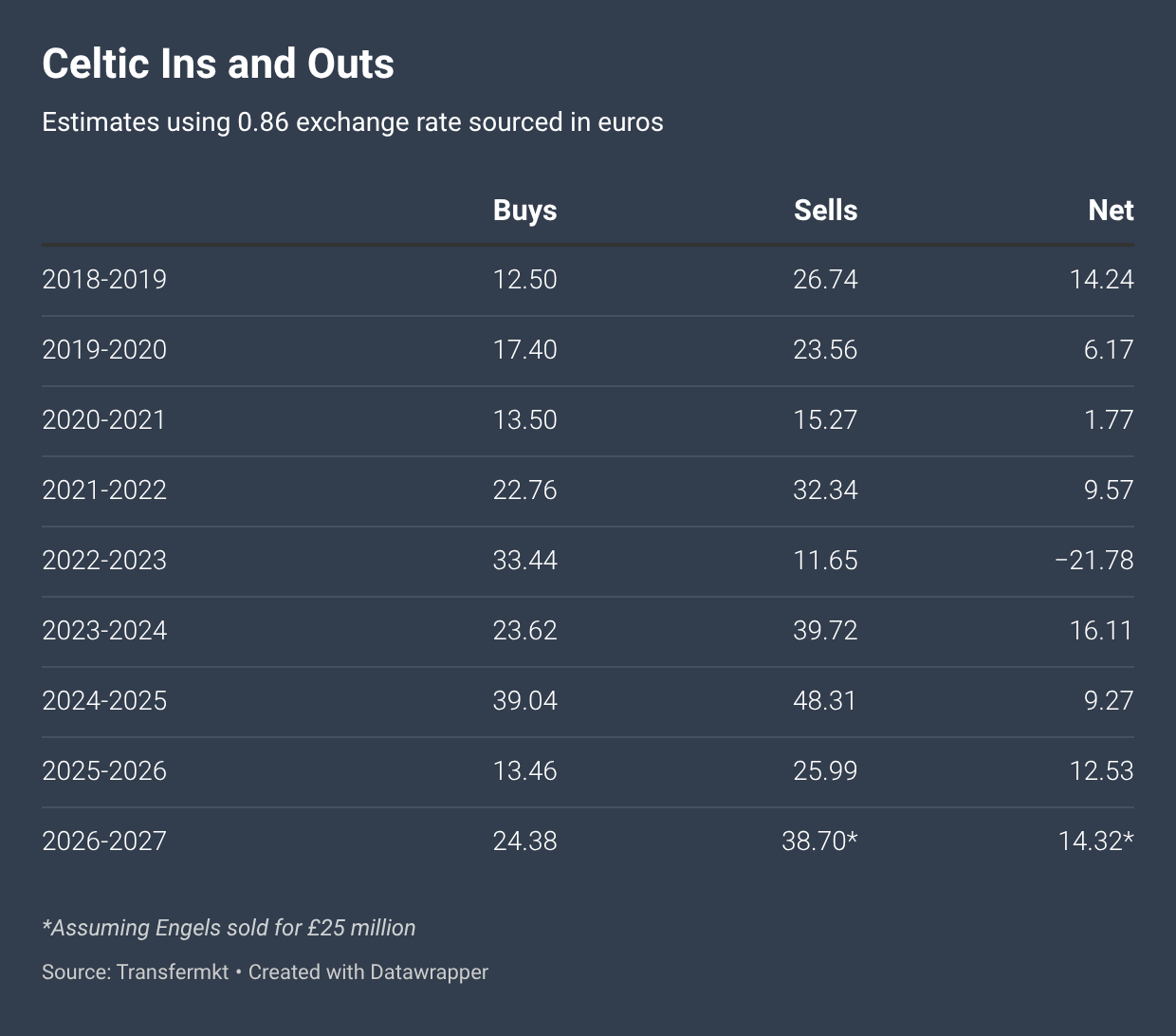
Because that has been Celtic’s recent history!
It is also why I have disagreed with much of the related criticisms over last season about the club being “cheap.”
The current season’s data assumes £9 million for Hassan, £6 million for Baur, and the sale of Engels for £25 million. Obviously, this is an exercise using estimates in order to try and provide context for what is unfolding.
The club tried to spend over £10 million on Kasper Dolberg last September, which would have taken the buys last season right into the range of recent context.
This first section has nothing to do with whether the players signed/sold have been wise, but rather a simple examination of ins and outs relative to fees. In a scenario where Hatate, Johnston (possibly less likely now), and Nygren exit this summer, spending of £40-£50 million on fees would be inline with recent behavior.
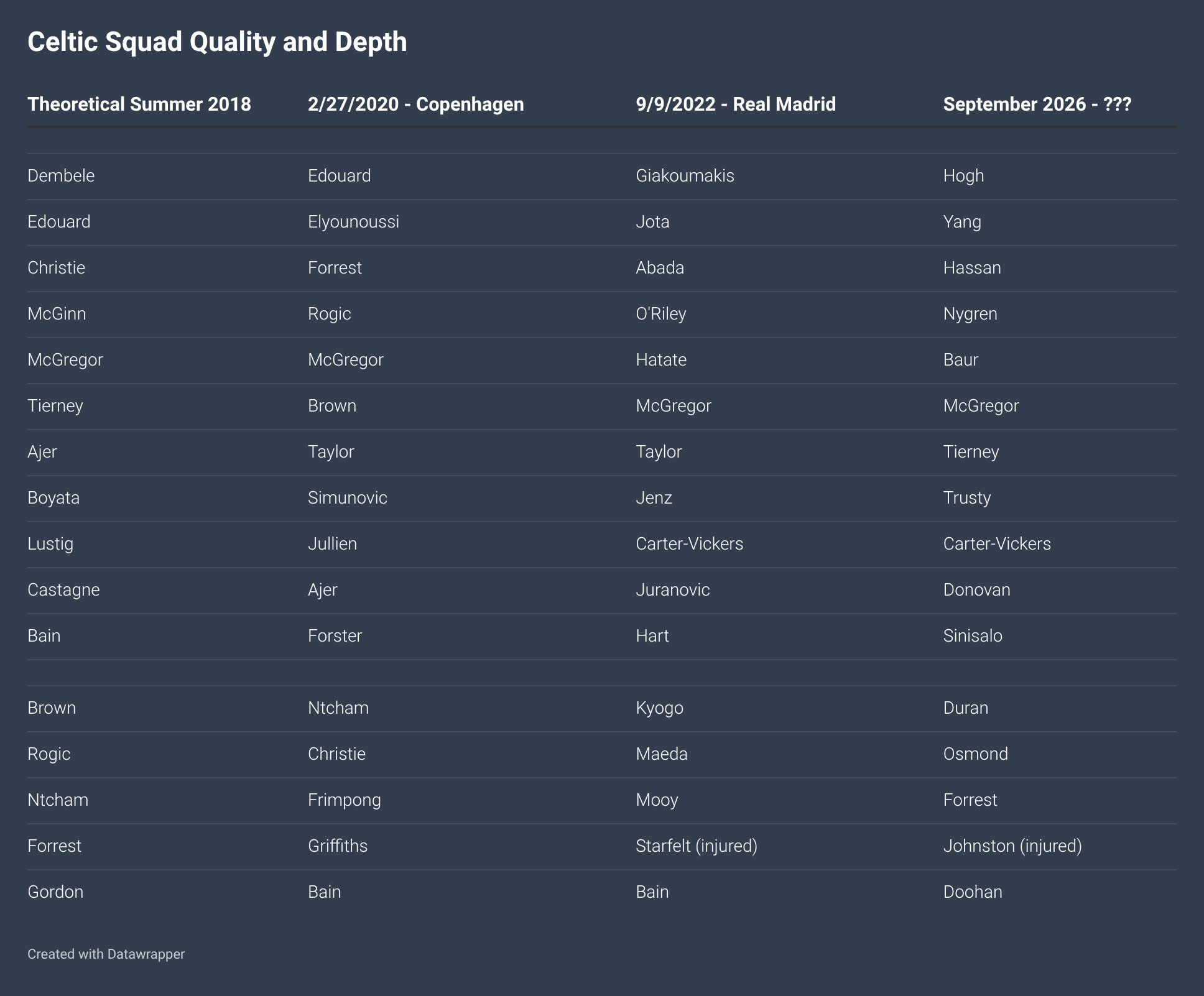
Broader context on the state of the squad is also vitally important, obviously.
Coming off what was an extremely chaotic season at the club, including a material amount of severe long term injuries to key players, the arrival of Hogh, Hassan, Duran, and Baur certainly feels pretty good.
But how good is the squad relative to recent history?
Summer 2018 was a sliding doors point for Celtic, in my opinion. It ended up being quite a mess that ultimately manifested in the acrimonious departure of Brendan Rodgers the following February, and took place as the analytics revolution was still relatively early.
It was around that time, according to co-founder of Statsbomb, Ted Knutson, that Celtic were an early adopter of his company’s higher quality data. My interview with Ted last summer where he shared that history is available for subscribers here.
I stress that the first column in the graphic above is HYPOTHETICAL and done using names that were rumored at the time. I am not suggesting the likes of Castagne or McGinn were ever close to joining Celtic, but using them as part of displaying the level of quality and depth that seemed plausible.
Like last summer, the specific details of what occurred in summer 2018 is probably never to be known by the public, with different versions from the main people involved as his human nature.
A common thread across the other two squads listed is that neither manifested in relative success at the European level, for a variety of reasons, but were good enough to maintain domestic hegemony. Indeed, that issue has been persistent for nearly a quarter century, at this point.
As we stare down another Champions League playoff qualifier versus LASK, and hopefully entry into the league phase, what is the quality and depth of the current squad relative to the ones I have shown above?
What progress has been made to make the team more competitive at that level?
Have the persistent issues in midfield and in transition been addressed?
The 2019-2020 squad listed above had youth, athleticism, and high levels of technical skill in midfield, though it was materially misused, in my opinion.
While diminished from his Barcelona-legend period, Forster was still capable of winning a game(s).
Is Sinisalo as number 1 likely to win games like Forster did at times? Would a signing like Nick Pope be more like Forster vs Lazio and Schmeichel 2024-2025, or Joe Hart at Celtic?
Much may still change between now and September 4th. The exit of a manager with a long history of attempting to “blow up” the recruitment process at clubs where he’s worked suggests that a major impediment to getting deals done was excised, for a second time.
In many ways, we may be on a Back to the Future-like journey, with Martin O’Neill as manager and getting the squad depth and quality directionally improved versus last season’s.
But is that path enough to stem the trend seemingly in place since that fateful summer of 2018 and add another chapter to the O’Neill storybook?
If only O’Neill could borrow Marty’s DeLorean and bring Henrik Larsson Back to the Future.
Great Scott (Brown)!!!!